
Arm has opened a new chip design center in Bengaluru focused on advanced 2nm chips. Union IT minister Ashwini Vaishnaw called it a milestone for India's semiconductor goals, making Arm the second company after Renesas to reach this level domestically.
According to The Economic Times, Money Control, and CNBC-TV18, Arm has inaugurated a new design center in Bengaluru that will focus on developing some of the world's most advanced chips, including at the 2nm level. India's Union Electronics and IT Minister Ashwini Vaishnaw, who opened the facility on September 16, 2024, said the initiative makes Arm the second company after Renesas to pursue such advanced design in India. He noted that the chips will power AI servers, drones, and smartphones, underscoring India's rising role in global semiconductor research and development.
Government strategy expands beyond design
Vaishnaw highlighted that Arm's move is part of a broader strategy to position India as a hub for cutting-edge chip design while building capacity in mature nodes. Under the India Semiconductor Mission (ISM), the government has announced 10 semiconductor units — two fabrication plants and eight assembly, testing, marking, and packaging facilities — with Gujarat's Sanand site expected to deliver the first made-in-India chip. Pilot production at additional units is also set to begin soon.
Comprehensive ecosystem development
The minister emphasized the importance of developing a comprehensive ecosystem, encompassing design, manufacturing, equipment, materials, and talent. He pointed to partnerships with ASML, IBM Albany, and IMEC, as well as India's work to secure rare earth elements and expand research infrastructure. The government is supporting 278 institutions with access to advanced design tools, which have already enabled students to tape out 28 chip designs domestically. Plans to modernize the Semiconductor Lab in Mohali are also underway, aimed at expanding production and providing startups and researchers with facilities to validate their designs without relying on overseas fabrication facilities.
Strategic roadmap for self-reliance
Looking ahead, Vaishnaw said ISM 2.0 will place greater emphasis on equipment and materials to ensure the long-term sustainability of the ecosystem. He also announced efforts to create 25 strategic chipsets for domestic and global markets with intellectual property rooted in India. "Our ambition is to develop the complete semiconductor stack," he said, adding that the momentum shown by companies such as Arm reflects the country's growing talent base and the government's commitment to making India a critical site for advanced semiconductor research and development.


Stay up to date with the latest in industry offers by subscribing us. Our newsletter is your key to receiving expert tips.

As the memory chip shortage is expected to persist through 2027, independent smartphone and laptop manufacturers are being forced to redesign products, screen incoming chips for counterfeit or substan
Yageo posted year-over-year and month-over-month revenue growth in August, extending its streak of record monthly highs to a sixth straight month. The passive components maker said strong AI-related d
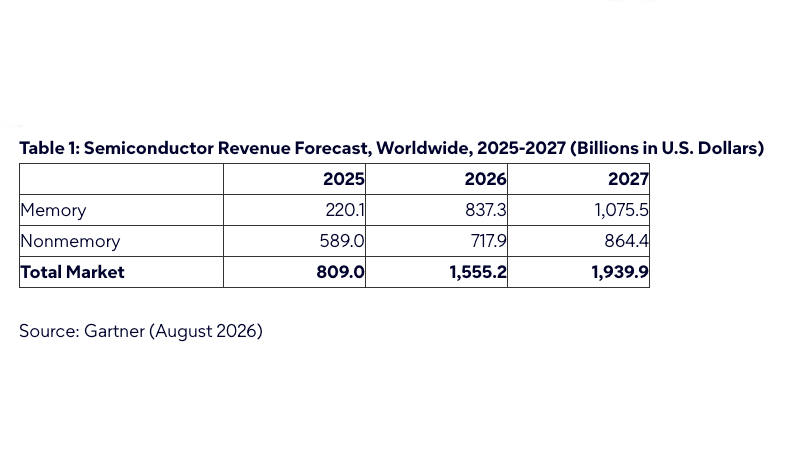
Gartner's latest forecast shows that "global semiconductor revenue is expected to reach US$1.555 trillion in 2026, up 92% from US$809 billion in 2025, and is projected to increase further to US$1.


