As the global semiconductor market enters the fourth quarter of 2026, supply and demand dynamics continue to evolve. Demand from AI servers, data centers, and automotive electronics remains strong, tightening supply for certain high-performance components. Meanwhile, demand in the consumer electronics market remains relatively stable, while some general-purpose products continue to face downward pricing pressure.
Market developments in October highlighted a clear divergence across component categories. Enterprise SSDs continued to see price increases, while prices for some consumer SSDs softened. In the CPU market, manufacturer-led price adjustments coincided with changes in channel pricing, while FPGA supply remained tight. Meanwhile, selected analog and power management ICs, passive components, and power semiconductors experienced price increases or extended lead times, particularly in higher-end product segments.
Overall, demand related to AI continues to be a major factor shaping component market supply and demand. Pricing and supply conditions are becoming increasingly differentiated across product categories and application sectors.
1. Memory: Q4 Price Increases Moderate, with Enterprise SSDs Leading the Market
Supply and demand divergence continues across the memory market. Demand for enterprise storage is rising alongside the expansion of AI servers and data centers, keeping supplies of high-performance products relatively tight. In contrast, demand from consumer electronics and mobile devices remains relatively weak, with some consumer memory products experiencing price declines.
SSD: Consumer Product Prices Ease, While Enterprise Demand Remains Strong
Affected by subdued consumer electronics demand, channel inventory levels, and adjustments in procurement strategies, prices for some consumer SSDs and lower- to mid-capacity products have declined. Price reductions have been reported across selected SATA and PCIe products.
In contrast, enterprise SSDs continue to benefit from demand driven by AI servers and data center expansion. Demand for high-capacity products remains strong, while available supply is relatively tight. TrendForce forecasts that contract prices for enterprise SSDs will increase by 23%–28% quarter over quarter in Q4 2026, significantly outpacing other memory categories.
DRAM: Prices Continue to Rise, Although Overall Increases Are Moderating
Growing demand for AI servers and adjustments to manufacturers' capacity allocation continue to influence DRAM supply. Demand for server DRAM and other high-value-added memory products remains robust, resulting in relatively tight supply. Changes in production capacity allocation are also affecting the traditional DRAM market.
TrendForce forecasts that conventional DRAM contract prices will increase by 10%–15% quarter over quarter in Q4 2026. Although prices are expected to continue rising, the overall increase is projected to moderate compared with previous quarters, indicating a more measured pace of market growth.
NAND Flash: Contract Prices Continue to Rise, While Spot Market Conditions Vary
The NAND Flash market is also benefiting from growing enterprise storage demand. However, market performance varies across applications and sales channels. TrendForce forecasts that NAND Flash contract prices will increase by 15%–20% quarter over quarter in Q4 2026.
2. Analog and Power Management ICs: AI Demand Supports Selected Products, While Market Divergence Persists
Demand for power management and high-performance analog ICs continues to grow across AI servers, automotive electronics, and industrial equipment, tightening supply for selected products. AI server-related power management components are attracting particularly strong market interest. Meanwhile, high-precision signal chain products are showing a clear divide between constrained high-end models and relatively stable general-purpose products.
PMICs and Power Management ICs: Strong AI-Related Demand Drives Diverging Price Trends
Growing demand for AI server power solutions has increased market interest in related PMICs and power management ICs. For example, selected server power-related models in TI's TPS and UCC series are facing tight spot market availability, with spot prices rising by approximately 15%–85%, depending on the specific model.
By comparison, general-purpose PMICs and LDO products have seen more moderate price movements. Prices for selected models have increased by approximately 5%–15%, while some general-purpose models have experienced price declines following new inventory arrivals.
In addition, ADI's LT series of highly integrated power modules is attracting increased inquiries for applications in AI accelerator cards and industrial equipment, with market interest continuing to grow.
Signal Chain ICs: Tight Supply for High-Precision and Automotive-Grade Products, While General-Purpose Devices Remain Stable
Overall demand for signal chain products is recovering relatively slowly. However, high-speed, high-precision, and automotive-grade products continue to face certain supply constraints. Selected models in ADI's ADM, ADR, and ADuM series have experienced declining inventory levels and extended lead times, covering applications such as amplifiers, voltage references, and digital isolation.
In contrast, general-purpose operational amplifiers, standard data converters, and analog switches remain relatively well supplied, with no widespread shortages reported. Overall, supply pressure in the signal chain segment remains concentrated in high-performance products and models designed for specific applications.
3. Logic and Processors: Diverging CPU Supply Conditions and Tightening FPGA Availability
Supply and demand conditions in the logic and processor market are becoming increasingly differentiated. Consumer CPU channel supply remains relatively stable, although some manufacturers have announced price adjustments. Lead times for selected server and industrial processors have also increased. Meanwhile, FPGA availability remains tight for certain models due to demand and capacity allocation constraints, creating further pricing and delivery pressures.
CPU: Manufacturer Price Adjustments Coincide with Channel Market Changes, While Lead Times Extend for Selected Products
Overall supply in the consumer CPU market remains relatively stable, although market conditions vary across Intel and AMD platforms and individual models. No widespread supply shortages have emerged in distribution channels. However, manufacturers have begun signaling price adjustments. According to market feedback, Intel implemented price increases of approximately 10% on selected products in October, while Qualcomm adjusted prices on certain products effective October 1, with increases of approximately 10%.
In the server CPU segment, increased shipments of selected Intel 5th and 6th Generation Xeon processors have improved availability for some models. However, individual products continue to face supply shortages, resulting in uneven overall supply conditions.
Regarding lead times, procurement cycles for selected CPU products have extended from the typical 16–20 weeks to approximately 25–30 weeks. Selected Intel industrial and embedded processors, including the N95, N97, N100, and N150, remain relatively limited in supply, resulting in longer procurement cycles.
FPGA: Tight Supply for High-End and Mature Platforms, with Manufacturer Price Adjustments Underway
Market prices for selected high-end Xilinx models have increased by approximately 30%–80% compared with the end of 2025. Selected mid-range Artix-7 and Kintex-7 products have recorded increases of approximately 20%–50%, with some constrained models becoming extremely difficult to source despite high market prices.
Selected Altera MAX 10 models, including the 10M08, 10M02, and 10M04, are also experiencing significant supply constraints.
Regarding manufacturer pricing, AMD/Xilinx plans to adjust prices for selected products effective December 27, 2026. Lattice also plans to implement price increases effective November 1, with a baseline increase of approximately 30%. Adjustments for certain legacy models may be even higher.
General-Purpose Logic and Industrial Control Products: Overall Demand Remains Stable, While Selected Products Have Extended Lead Times
Compared with the high-end FPGA market, demand for some general-purpose MCUs and entry-level logic ICs remains in an adjustment phase. Customers continue to exercise caution in procurement, and inventory digestion is not yet complete. As a result, prices are generally stabilizing, with localized adjustments across selected products.
Nevertheless, certain industrial and automotive-grade products continue to face extended lead times. Market feedback indicates that selected NXP MC74X and FLEX series models have lead times of approximately 36–46 weeks.
4. Passive Components: High-Capacitance MLCCs and Tantalum Capacitors Face Supply Pressure, with Lead Times Varying Across Products
Growing demand for high-performance and high-reliability passive components in AI servers, automotive electronics, and industrial power systems is tightening supply for selected high-capacitance, high-voltage, and automotive-grade products. By comparison, general-purpose consumer products remain relatively stable. Lead time differences across brands, specifications, and applications are becoming increasingly pronounced.
MLCCs: Tight Supply for High-Capacitance, High-Voltage, and Automotive-Grade Products
Supply pressure in the MLCC market is particularly evident in high-capacitance, high-voltage, automotive-grade, and AI server-related products. Lead times for selected Samsung Electro-Mechanics MLCC products have increased from approximately 30 weeks to 52 weeks. Meanwhile, Yageo has reportedly planned price adjustments for certain high-capacitance products, with market expectations suggesting that increases for selected products could reach 50% or more.
In contrast, general-purpose low-capacitance MLCCs remain relatively well supplied, with lead times for some products declining to approximately 16 weeks. Prices have also remained relatively stable.
Tantalum Capacitors: Significant Lead Time Extensions for Selected Products
In the tantalum capacitor segment, supply cycles for selected polymer tantalum capacitors have extended further. Lead times for certain Panasonic polymer tantalum capacitors have reached as long as 84 weeks. NIC has also reportedly suspended orders for selected molded tantalum capacitors.
Resistors: Significant Lead Time Differences Across Brands and Product Types
The resistor market continues to show varying supply conditions, with considerable differences in lead times across manufacturers and product types. Selected Samsung thick-film and thin-film resistors have lead times of approximately 44–46 weeks, while selected Yageo products are around 24–26 weeks. By comparison, selected ROHM products have lead times of approximately 8–10 weeks.
Inductors and Other Capacitors: Supply Pressure Increases for High-Performance Products
In the inductor segment, selected TDK filters have lead times of approximately 30–32 weeks, while certain Murata inductors have lead times of approximately 30–36 weeks. As demand for server power supplies, new energy systems, and automotive electronics continues to grow, the supply conditions of power inductors, molded inductors, and high-saturation-current inductors warrant close attention.
In addition, selected high-end aluminum electrolytic and film capacitors are also experiencing relatively firm pricing and extended lead times, driven by growing demand from AI server power supplies, automotive applications, and industrial power systems.
5. Discrete Semiconductors: Power Semiconductor Prices Rise, While MOSFET and SiC Supply Remains Tight
Growing demand for power semiconductors across AI servers, automotive electronics, and energy storage applications is tightening supply for selected high-voltage, high-power, and automotive-grade devices. MOSFETs, SiC devices, and IGBTs have experienced particularly noticeable changes in pricing and lead times, while general-purpose low-voltage MOSFETs and small-signal devices remain relatively well supplied.
MOSFETs: Tight Supply for High-Voltage and Automotive-Grade Products, with Extended Lead Times for Selected Models
Growing demand from AI server power supplies and automotive electronics is increasing supply pressure on high-voltage and automotive-grade MOSFETs. Currently, lead times for selected Vishay MOSFETs used in AI-related applications have exceeded 104 weeks, while automotive-grade MOSFET lead times have also reached more than 52 weeks.
In addition, lead times for selected onsemi power discrete products have increased. Average lead times have extended from 27 weeks to 32 weeks, with certain models reaching 40–52 weeks.
SiC and IGBTs: Growing Demand from High-Power Applications Extends Supply Cycles
Driven by the development of electric vehicles, energy storage systems, and high-voltage power architectures for AI servers, demand for SiC MOSFETs and IGBTs continues to increase, tightening supply for selected products.
For example, certain onsemi SiC products continue to face extended lead times. Selected Infineon power devices for AI power supply and automotive applications are also experiencing supply pressure, with some models subject to allocation-based supply.
Diodes and Other Discrete Devices: Price Adjustments Across Selected Products, with Overall Channel Prices Rising
Beyond MOSFETs and SiC devices, selected diodes, rectifiers, and protection components have also experienced price adjustments due to changes in costs and supply-demand conditions.
According to UBS's October channel survey, channel prices for discrete semiconductors increased by approximately 34% month over month, representing the largest increase among the surveyed categories, including analog ICs, power management ICs, discrete semiconductors, and MCUs.
Regarding manufacturer pricing, onsemi implemented price adjustments of approximately 10%–20% across multiple product series effective October 10. Taiwanese manufacturers including Panjit and Taiwan Semiconductor have also adjusted prices for selected products since October, with increases of approximately 10%–15%.
6. Market Outlook: Structural Divergence Continues Across Component Categories
A review of market developments across major electronic component categories indicates that supply and demand divergence in the semiconductor industry remains pronounced. Growing demand from AI servers, data centers, and automotive electronics is driving price increases and tighter supply for selected high-performance components. Meanwhile, consumer electronics and general-purpose products remain relatively stable, with some continuing to face downward pricing pressure.
Overall, the electronic components market is experiencing increasingly differentiated trends across product categories and application sectors. As market demand evolves and manufacturers continue to adjust capacity allocation, pricing movements and supply conditions across different component categories will remain important factors to monitor.
New Han Technology will continue to monitor global electronic component market developments and provide customers with diversified component sourcing and supply chain services.


Stay up to date with the latest in industry offers by subscribing us. Our newsletter is your key to receiving expert tips.

As the memory chip shortage is expected to persist through 2027, independent smartphone and laptop manufacturers are being forced to redesign products, screen incoming chips for counterfeit or substan
Yageo posted year-over-year and month-over-month revenue growth in August, extending its streak of record monthly highs to a sixth straight month. The passive components maker said strong AI-related d
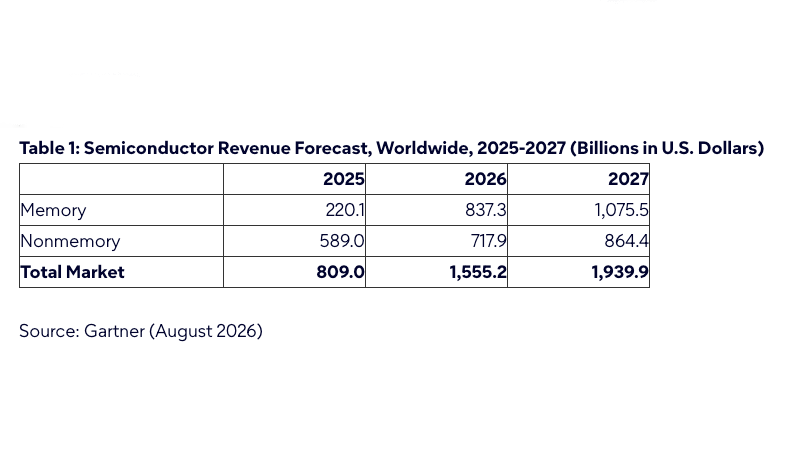
Gartner's latest forecast shows that "global semiconductor revenue is expected to reach US$1.555 trillion in 2026, up 92% from US$809 billion in 2025, and is projected to increase further to US$1.


