STMicroelectronics, has combined its cutting-edge LED-control know-how with advanced power technologies in a new all-in-one LED control chip that enables future luminaires to save more energy and deliver better user experiences.All-in-one high-voltage LED-lighting control chip meets latest demands for efficient dimmingEnhanced accuracy and fast start-up ensure superior user experienceThe HVLED001B controller simplifies designing LED-lighting modules, maximizes energy efficiency at all dimming levels, and ensures smoother brightness control. Lighting innovator TCI of Italy, a lead customer, has already designed forthcoming products containing the new chip to increase energy savings, safety, and usability.
The HVLED001B is the second generation of ST’s LED driver family containing high-voltage startup and sensing circuitry that simplifies connection to the AC line.
Its advanced features support multi-platform reuse and compliance with the latest lighting regulations, and include:Very accurate line and load regulation over wide range to ensure constant output voltage or output currentConstant output voltage regulation, with no need of an optocoupler, to ensure voltage remains below recognized 60V safe limit, improving the application robustnessFrequency foldback for improved efficiency and regulation at light load with good efficiency at medium loadAccurate and smooth dimmingPower-conversion efficiency greater than 90%No-load power consumption less than 100mWPower factor greater than 0.9, Total Harmonic Distortion (THD) below 10%Low EMI at light load and medium loadBuilt-in over-current, input over-voltage, brownout, and optocoupler failure protectionST’s smart Auto-Reload Timer (ART) ensures latch-free protection for enhanced safetyThe HVLED001B is in production now, housed in the familiar and compact SSOP10 package.


Stay up to date with the latest in industry offers by subscribing us. Our newsletter is your key to receiving expert tips.

As the memory chip shortage is expected to persist through 2027, independent smartphone and laptop manufacturers are being forced to redesign products, screen incoming chips for counterfeit or substan
Yageo posted year-over-year and month-over-month revenue growth in August, extending its streak of record monthly highs to a sixth straight month. The passive components maker said strong AI-related d
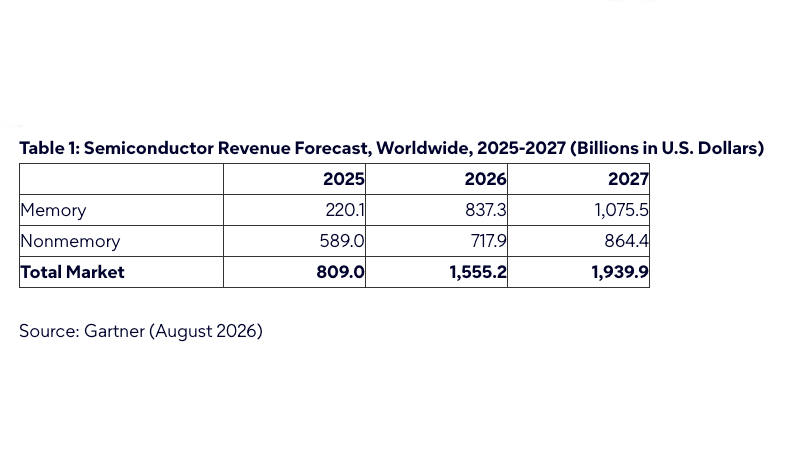
Gartner's latest forecast shows that "global semiconductor revenue is expected to reach US$1.555 trillion in 2026, up 92% from US$809 billion in 2025, and is projected to increase further to US$1.


