Designed for modularity, versatility, and safety, the NHR 4800 is highly compact and looks to address the needs of battery testing across research, validation, production, and second-life applications in automotive, aerospace and the energy industries.
The data and insights from battery testing has a major impact on battery performance, quality, and overall adoption of new technologies like electric vehicles and energy storage systems and the demand for more efficient test is accelerating the next generation of battery test systems.
The NHR 4800 is highly modular and scalable, allowing engineering teams leading the shift to electric mobility and renewable energy to efficiently scale their test capabilities. When combined with NI’s open and flexible software-defined battery test approach, engineers can easily adjust and evolve for future battery test requirements.
“Battery testing can be a competitive advantage for EV manufacturers, and NI provides them with an open, flexible, and cost-effective platform to achieve it,” said Drita Roggenbuck, Senior VP and GM of Transportation, NI. “The NHR 4800 delivers best-in-class, high-power testing in a safe and compact system to provide our customers the performance necessary for todays and tomorrow’s battery testing requirements across multiple industries.”
The NHR 4800 is capable of functioning as a battery cycler, DC source, DC load, battery emulator, and amplifier for power-level hardware-in-the-loop testing. It delivers up to 80 V and 400 A in a single-4U chassis while delivering scalable power ranging from 16.5 kW up to 165 kW. This wide operating envelope makes the NHR 4800 suitable for testing low to mid-range battery modules and packs, fuel cells, energy storage systems, and solar PV systems and can be used to replace multiple instruments in the lab and production floors.
Key features include:


Stay up to date with the latest in industry offers by subscribing us. Our newsletter is your key to receiving expert tips.

As the memory chip shortage is expected to persist through 2027, independent smartphone and laptop manufacturers are being forced to redesign products, screen incoming chips for counterfeit or substan

Yageo posted year-over-year and month-over-month revenue growth in August, extending its streak of record monthly highs to a sixth straight month. The passive components maker said strong AI-related d
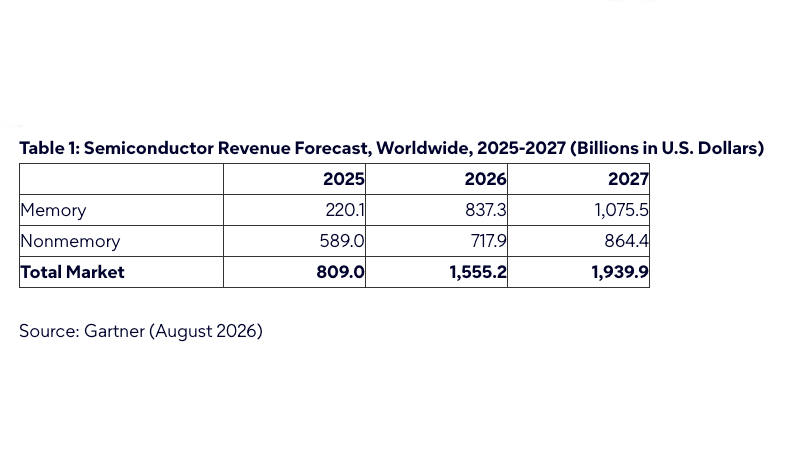
Gartner's latest forecast shows that "global semiconductor revenue is expected to reach US$1.555 trillion in 2026, up 92% from US$809 billion in 2025, and is projected to increase further to US$1.


