Taiwanese chip manufacturer TSMC has announced a $100 billion investment in the United States, aiming to build five additional semiconductor facilities.
The plan was revealed by TSMC CEO C.C. Wei alongside President Donald Trump at the White House, highlighting efforts to reduce US reliance on Asian-made chips.
The expansion includes three new fabrication plants, two advanced packaging facilities, and a research and development centre.
Higher costs and regulatory approvals remain key challenges for TSMC, which has already faced delays at its first Arizona plant. Taiwan’s government is set to review the investment to ensure it aligns with national interests while keeping the most advanced manufacturing processes on the island.
TSMC has not yet disclosed which chip technology will be used in the new US facilities, though a second Arizona plant is expected to begin producing 2-nanometer chips in 2028.
The investment follows US government efforts to strengthen domestic semiconductor production under the CHIPS and Science Act. Trump officials have reportedly explored a deal for TSMC to take a stake in an Intel factory unit.
With billions in subsidies and tax incentives at stake, the investment reinforces the US push to secure semiconductor supply chains amid growing geopolitical tensions over Taiwan.


Stay up to date with the latest in industry offers by subscribing us. Our newsletter is your key to receiving expert tips.

As the memory chip shortage is expected to persist through 2027, independent smartphone and laptop manufacturers are being forced to redesign products, screen incoming chips for counterfeit or substan
Yageo posted year-over-year and month-over-month revenue growth in August, extending its streak of record monthly highs to a sixth straight month. The passive components maker said strong AI-related d
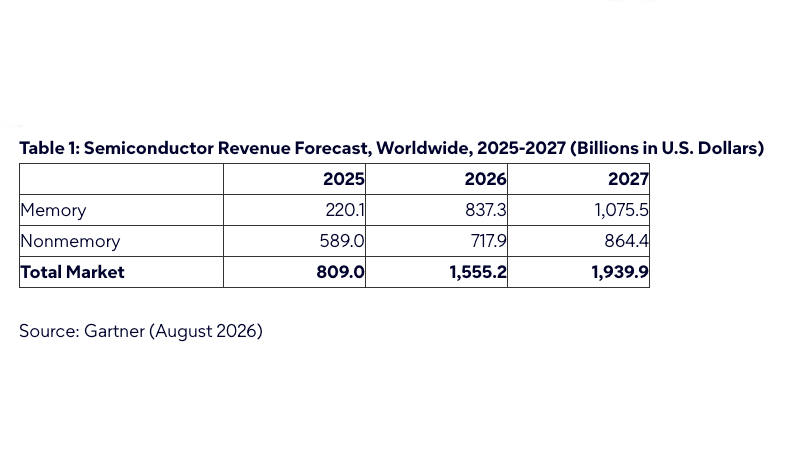
Gartner's latest forecast shows that "global semiconductor revenue is expected to reach US$1.555 trillion in 2026, up 92% from US$809 billion in 2025, and is projected to increase further to US$1.


