An unexpected upturn in Q2 has resulted in a better than anticipated result for the 2023 semiconductor market, said Malcolm Penn (pictured) CEO of Future Horizons, at the company’s IFS2023 forecast seminar yesterday.
The industry down-cycle bottomed out in Q1 which was a quarter earlier than the historical trend indicated. “The 18th industry up-cycle has started,” said Penn.
In Q2, the market increased by 6%, instead of taking an expected 5% drop and, with 6% growth forecast in Q3 followed by 1% growth in Q4, the full year forecast improves from an anticipated 22% decline to a 10% decline.
Inventory depletion will not, however, be over before the end of the year, and it could be longer if end demand softens.
Future Horizons’ forecast for next year is a minus 1% Q1, a plus 2.3% Q2, a plus 6.3% Q3, and a minus 1.5% Q4 for full year growth of 9% to deliver a market worth $562 billion.
There should be a return to the historical 8% unit growth trend line next year, however the capex overspend will keep utilisation rates low and excess capacity will keep a tight rein on ASPs.


Stay up to date with the latest in industry offers by subscribing us. Our newsletter is your key to receiving expert tips.

As the memory chip shortage is expected to persist through 2027, independent smartphone and laptop manufacturers are being forced to redesign products, screen incoming chips for counterfeit or substan

Yageo posted year-over-year and month-over-month revenue growth in August, extending its streak of record monthly highs to a sixth straight month. The passive components maker said strong AI-related d
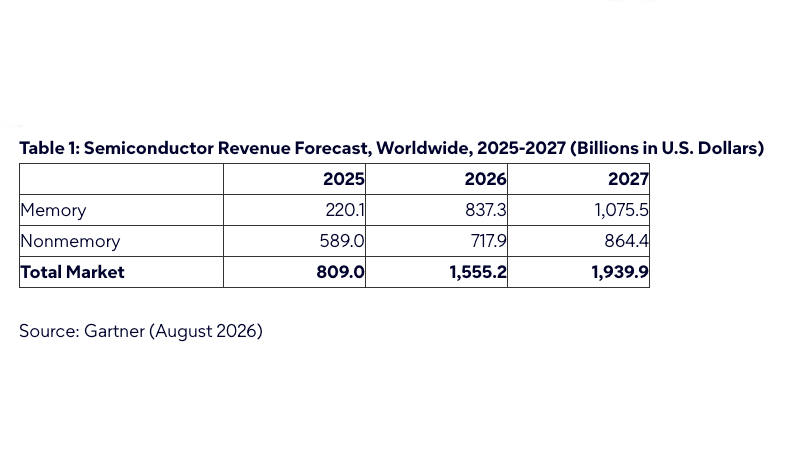
Gartner's latest forecast shows that "global semiconductor revenue is expected to reach US$1.555 trillion in 2026, up 92% from US$809 billion in 2025, and is projected to increase further to US$1.


