ordic Semiconductor has taken 5GHz radios out of its recent nRF7002 Wi-Fi 6 companion IC, to create the 2.4GHz-only nRF7001.
“nRF7001 lowers the cost of the bill-of-materials for designs requiring single band capability for smart home, smart city, industrial automation and other low power Wi-Fi IoT applications”, it said. It “offers all the Wi-Fi functionality of the nRF7002, including compliance with the latest standard and power saving features”.
As a radio companion, it can be used with the company’s nRF52 (Nordic suggests the nRF52840) and nRF53 multi-protocol systems-on-chip ICs, the nRF9160 cellular IoT (LTE-M/NB-IoT) system-in-package, and third-party comms ICs.
Amongst its features are secured Wi-Fi connectivity, Wi-Fi-assisted location based on SSID (service set identifier) scanning, Station (STA), software-emulated Access Point (SoftAP), Wi-Fi Direct operation and compatibility with Wi-Fi 4 (IEEE 802.11b, a, g, n) as well as Wi-Fi 6 (ax). Target Wake Time (TWT) is supported for power saving.
Interfacing with its host is via SPI or Quad SPI (QSPI), and the output is a single spatial stream, 20MHz channel bandwidth, 64 QAM (MCS7), OFDMA, up to 86Mbit/s PHY throughput and BSS colouring.
Packaging is 6 x 6mm QFN.
To support design, the existing nRF7002 development kit can be used, as nRF7001 emulation on that is supported by the ‘nRF Connect’ SDK (software development kit).


Stay up to date with the latest in industry offers by subscribing us. Our newsletter is your key to receiving expert tips.

As the memory chip shortage is expected to persist through 2027, independent smartphone and laptop manufacturers are being forced to redesign products, screen incoming chips for counterfeit or substan
Yageo posted year-over-year and month-over-month revenue growth in August, extending its streak of record monthly highs to a sixth straight month. The passive components maker said strong AI-related d
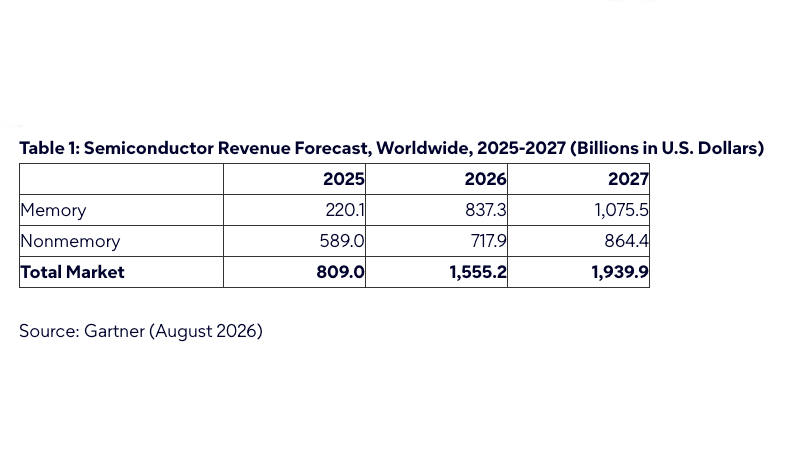
Gartner's latest forecast shows that "global semiconductor revenue is expected to reach US$1.555 trillion in 2026, up 92% from US$809 billion in 2025, and is projected to increase further to US$1.


