Infineon is sampling CoolSiC MOSFET 400V family based on the second generation (G2) CoolSiC technology introduced earlier this year.
The family moves into production in October.
The new MOSFET portfolio was specially developed for use in the AC/DC stage of AI servers, complementing Infineon’s recently announced PSU roadmap.
The devices are also suitable for solar and energy storage systems (ESS), inverter motor control, industrial and auxiliary power supplies (SMPS) as well as solid-state circuit breakers for residential buildings.
Implemented in a multi-level PFC, the AC/DC stage of the AI Server PSU can attain a power density of more than 100 W/in³ and is proven to reach 99.5 percent efficiency. This is an efficiency improvement of 0.3 percentage points over solutions using 650 V SiC MOSFETs.
The system solution for AI Server PSUs is completed by implementing CoolGaN transistors in the DC/DC stage.
With this combination of MOSFETs and transistors, the power supply can deliver more than 8 kW with an increase in power density by a factor of more than 3 compared to current solutions.
The new MOSFET portfolio comprises a total of 10 products: five R DS(on) classes from 11 to 45 mΩ in Kelvin-source TOLL and D²PAK-7 packages with .XT package interconnect technology.
The drain-source breakdown voltage of 400 V at T vj = 25°C. makes them suitable for use in 2- and 3-level converters and for synchronous rectification.
The components are 100 percent avalanche tested. The CoolSiC technology in combination with the .XT interconnect technology enables the devices to cope with power peaks and transients caused by sudden changes in the power requirements of the AI processor.
Both the connection technology and a low and positive R DS(on) temperature coefficient maintain performance under operating conditions with higher junction temperatures.


Stay up to date with the latest in industry offers by subscribing us. Our newsletter is your key to receiving expert tips.

As the memory chip shortage is expected to persist through 2027, independent smartphone and laptop manufacturers are being forced to redesign products, screen incoming chips for counterfeit or substan
Yageo posted year-over-year and month-over-month revenue growth in August, extending its streak of record monthly highs to a sixth straight month. The passive components maker said strong AI-related d
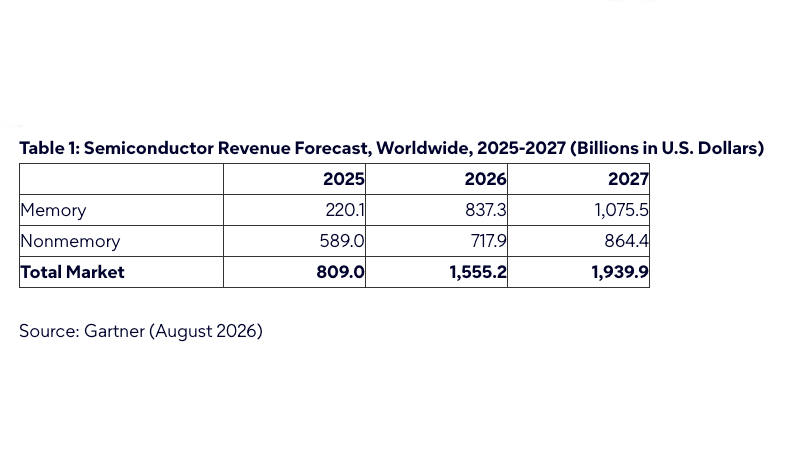
Gartner's latest forecast shows that "global semiconductor revenue is expected to reach US$1.555 trillion in 2026, up 92% from US$809 billion in 2025, and is projected to increase further to US$1.


