
Texas Instruments opens new tab beat third-quarter profit estimates on Tuesday, helped by a recovery in orders for its analog chips across segments and improving demand from China's automotive market, sending its shares up 4% in extended trading.
Sales of TI's semiconductors, which help power electronic devices, have been bolstered by improving orders from smartphone and PC providers, supported by a rebound in end-market demand.
Revenue from the automotive market also rose upper-single-digits sequentially, CEO Haviv Ilan said on a post-earnings call.
"There is momentum for EVs in China, our content is growing there, and that's what really drove the growth in the third quarter," Ilan said. However, some weakness is expected to persist in the remainder of the automotive market, he said.
The company recorded earnings of $1.47 per share for the three months ended Sept. 30, above estimates of $1.37, according to estimates compiled by LSEG.
Third-quarter revenue dropped 8% to $4.15 billion, the smallest decline in seven quarters.
"Bottom line, TI now sees cyclical recovery in the non-industrial end markets and expects the automotive market to continue to grow, driven by EV adoption in spite of the mixed demand from the non-Chinese auto OEMs," said Summit Insights analyst Kinngai Chan.
The results are closely watched as an indicator of demand across sectors since the company's chips find widespread application. It is also the first major U.S. chipmaker to report results for the September quarter.
INDUSTRIAL SORE SPOT
TI forecast fourth-quarter revenue and profit below estimates due to ongoing weakness in the industrial market as customers struggle to clear existing inventory.
The industrial segment, which utilizes chips for tasks such as automating factories, declined sequentially in the third quarter while all other end markets grew compared to the previous three-month period, the company said.
The company forecast revenue in the range of $3.70 billion to $4.0 billion, below analysts' average estimate of $4.07 billion.


Stay up to date with the latest in industry offers by subscribing us. Our newsletter is your key to receiving expert tips.

As the memory chip shortage is expected to persist through 2027, independent smartphone and laptop manufacturers are being forced to redesign products, screen incoming chips for counterfeit or substan

Yageo posted year-over-year and month-over-month revenue growth in August, extending its streak of record monthly highs to a sixth straight month. The passive components maker said strong AI-related d
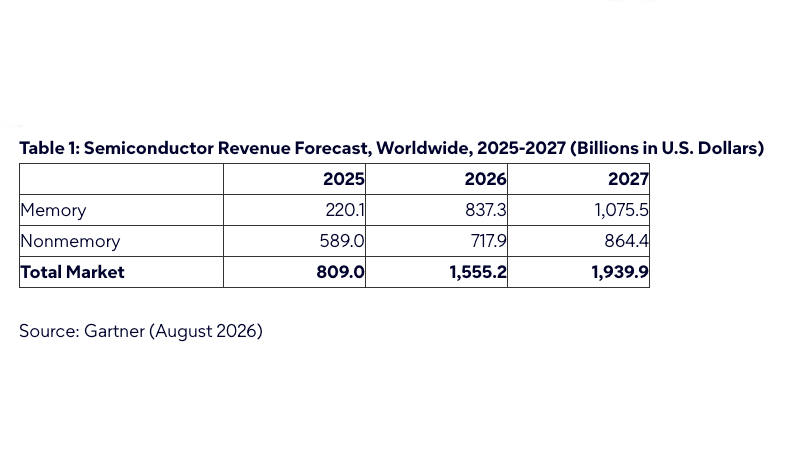
Gartner's latest forecast shows that "global semiconductor revenue is expected to reach US$1.555 trillion in 2026, up 92% from US$809 billion in 2025, and is projected to increase further to US$1.


