A special session at the recent 2024 IEEE Electronic Components and Technology Conference (ECTC), highlighted workforce challenges and showcased potential solutions.
These industries are being driven by demand in areas like AI, transportation electrification, automated manufacturing, data centre growth and complexity, and IoT devices, among others.
This growth has prompted substantial global investments in fabs and packaging infrastructure in Asia, Europe and North America, supported by government spending,
However, the corresponding surge in demand for skilled labour ranging from technicians to Ph.D.-level technologists poses a considerable challenge.
“In the microelectronics industry, the lack of enough trained and educated people in the pipeline brings the very real possibility that the design and manufacture of the devices we all depend on in this digital age will be impacted,” said TI’s Patrick Thompson.
Robert Geer from NY CREATES said each year there are ~43,000 STEM-related graduates from two- and four-year educational institutions in NY, but only relatively few of the two-year community college graduates are aware of the many advanced packaging and other microelectronics industry opportunities open to them.
NY CREATES’ key workforce development strategies comprise increased outreach to community colleges; tapping the pool of ~160,000 military veterans who enter the U.S. workforce each year, many of whom have transferrable skills; and reaching into the state’s K-12 teacher/student population to develop from an early age an awareness of the industry’s importance and the work opportunities available.
Among the many programs and initiatives NY CREATES uses to implement these strategies is a diverse set of job shadowing, internship and co-operative educational opportunities at the Albany, NY Nanotech Complex and TAP Packaging Facility, and at other NY CREATES facilities in the state.
Another example are the customized fab technician/service engineer training programs conducted in cooperation with industry. In 2023/2024:
>600 college/university students and professionals have participated in NY CREATES educational development activities.
There have been >850 participants in NY CREATES military/veterans workforce outreach programs.
>1,200 K-12 students and teachers have attended NY CREATES educational outreach programs.
John Oakley at the Semiconductor Research Corporation said workforce development is a critical enabler of the SRC’s Microelectronics and Advanced Packaging Technologies (MAPT) roadmap. That roadmap summarises the key drivers of technology progress, provides guidance on how to achieve key technical challenges, and offers ways to develop the workforce needed to bring them into reality.
He showed SRC figures indicating that while an additional 114,800 semiconductor-related jobs will be needed by 2030, only 19,000 are currently in the pipeline.
In addition, the workforce will need to be a multidisciplinary mix of engineers and technicians; some 60-70% of whom would be technicians.
Obstacles to developing this workforce include student lack of interest/motivation; the time lag to fill the pipeline from where we are now; how to finance workforce development; and determining the optimum scale of workforce development programs.
He pointed out that while SRC supplies ~20% of the semiconductor Ph.D. workforce in the U.S. and has the capability to increase output by 3-5 times to meet growing demand, only 13% of U.S. undergraduate students are pursuing STEM-related studies, and of those, just 0.2% ultimately join the semiconductor workforce.
On the graduate level, meanwhile, only 0.4% of STEM students go on to join the industry. SRC strategies to patch this “leaky pipeline” include providing more opportunities for hands-on experience, more/better access to training/mentors, financial and other incentives, leveraging the success of other programs conducted elsewhere; and working closely with industry, among others.


Stay up to date with the latest in industry offers by subscribing us. Our newsletter is your key to receiving expert tips.

As the memory chip shortage is expected to persist through 2027, independent smartphone and laptop manufacturers are being forced to redesign products, screen incoming chips for counterfeit or substan
Yageo posted year-over-year and month-over-month revenue growth in August, extending its streak of record monthly highs to a sixth straight month. The passive components maker said strong AI-related d
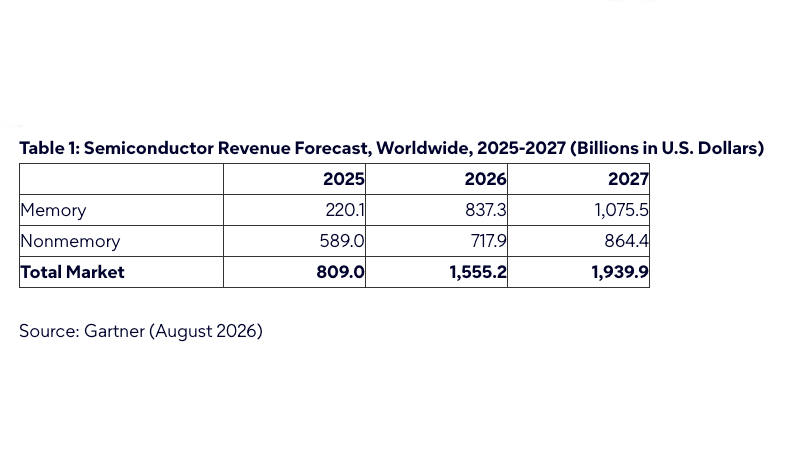
Gartner's latest forecast shows that "global semiconductor revenue is expected to reach US$1.555 trillion in 2026, up 92% from US$809 billion in 2025, and is projected to increase further to US$1.


