The SEMPER X1 LPDDR Flash provides safer, more reliable, and real-time code execution which is deemed critical for automotive domain and zone controllers. According to Infineon, the device delivers 8 times the performance of current NOR Flash memories and achieves 20 times faster random read transactions for real-time applications, enabling software-defined vehicles to deliver advanced features with enhanced safety and architectural flexibility.
Intelligence, connectivity, and complexity, along with safety and dependability requirements means that next-generation vehicles are increasingly reliant on state-of-the-art multi-core processors developed on advanced manufacturing processes.
Consequently, higher density embedded non-volatile memories are no longer seen as a viable cost option at these advanced nodes, and system architects need to consider using external NOR for code storage. These complex automotive real-time processors, however, demand more performance than current memories available on the market.
To address this, Infineon developed the SEMPER X1 with an LPDDR4 interface operating at 3.2 GBytes/sec and a multi-bank architecture to meet the performance and density requirements of domain and zone controllers.
“With the drive towards semi-autonomous vehicles and more sophisticated engine control, real-time decisions are critical to the dependability and safety of the vehicle and driver,” said Jim Handy, General Director of the semiconductor market research firm Objective Analysis. “Infineon’s LPDDR Flash memory should address these needs well in next-generation vehicles, providing real-time execute-in-place (XiP) memory and enabling it to scale independently of the processor.”
Source: New Electronic


Stay up to date with the latest in industry offers by subscribing us. Our newsletter is your key to receiving expert tips.

As the memory chip shortage is expected to persist through 2027, independent smartphone and laptop manufacturers are being forced to redesign products, screen incoming chips for counterfeit or substan

Yageo posted year-over-year and month-over-month revenue growth in August, extending its streak of record monthly highs to a sixth straight month. The passive components maker said strong AI-related d
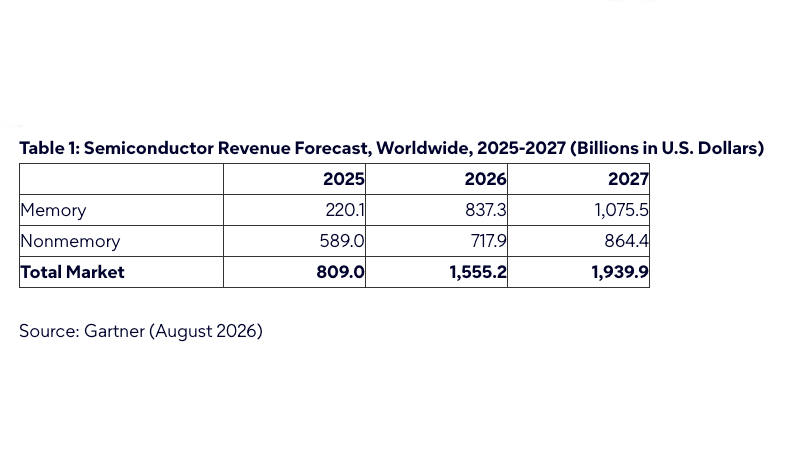
Gartner's latest forecast shows that "global semiconductor revenue is expected to reach US$1.555 trillion in 2026, up 92% from US$809 billion in 2025, and is projected to increase further to US$1.


