UMC held its shareholders' meeting on May 27, with CEO Jason Wang saying that as AI applications expand rapidly, long-term semiconductor demand still has room for growth. In addition to deepening its strengths in mature and specialty processes, UMC is also advancing next-generation technologies, including a US-based 12nm FinFET platform, advanced packaging, and silicon photonics, to prepare for future operating growth.
On capacity expansion, UMC CFO Chitung Liu said UMC(2303.TW) has doubled its interposer-related capacity from 3,000 wafers per month to 6,000 wafers per month, mainly in response to rising customer demand. The platform is currently still based mainly on 55/65nm technology, while any further expansion will move toward next-generation technologies.
Liu stressed that UMC's core rationale for entering advanced packaging is to provide customers with more supply chain options in a market currently dominated by a small number of players. However, since UMC does not have direct control over advanced AI chip design, it is still advancing through a co-development model with customers at this stage.
Liu acknowledged that UMC is currently focused on wafer-level packaging rather than the traditional OSAT back-end packaging model, mainly because the equipment and process technologies required for back-end packaging differ significantly from wafer foundry operations. UMC will therefore continue to develop around its own wafer manufacturing strengths.
On pricing strategy, UMC will carry out "selective price increases" in the second half of 2026, mainly due to rising raw material prices and the significantly higher cost of expanding capacity in Singapore compared with Taiwan.
UMC has long reduced costs through multiple sourcing and process simplification, with the aim of keeping cost reductions greater than price cuts. But in 2026, due to changes in raw material costs and the broader operating environment, costs have risen instead of falling, significantly increasing operating pressure.
Liu stressed that UMC is not taking an opportunistic approach by raising prices across the board. Instead, it hopes customers will recognise the technology and manufacturing value UMC provides. Existing long-term agreements will not be adjusted, but for new orders, new processes, and new capacity, the company hopes to moderately reflect current cost and investment pressures. As a result, it will adopt a selective and limited price increase strategy in the second half of 2026.
Liu also disclosed for the first time that UMC has begun discussing 2027 cooperation models with customers. These talks are not necessarily about price adjustments, but encompass broader negotiations covering future investment, cost structures, and market conditions, to find a "win-win solution" acceptable to both sides.
Singapore fab capacity coming online
Singapore production costs are relatively high, so local pricing levels are generally higher than in Taiwan. However, the site's geopolitical risk-hedging advantages continue to appeal to many customers. Many customers are willing to establish a second source in Singapore or add new tape-out plans there to diversify supply chain risks.
UMC's new Singapore fab is currently planned for a monthly capacity of about 12,000–13,000 wafers, with a possible future increase to 18,000 wafers. New capacity will come online gradually in 2026, but actual high-volume production may not begin until 2027. Products will mainly focus on 22/28nm and some specialty processes.
In the future, new technologies, including silicon photonics, advanced processes, and advanced packaging, could all become part of UMC's Singapore deployment options. The main structure of UMC's Singapore P4 fab has been completed, and the company will gradually introduce new technology platforms depending on customer demand and market conditions.
In terms of capacity utilisation, UMC's overall utilisation rate in the second quarter of 2026 is about 85%, with 12-inch fabs notably above the average. Some fabs are nearly fully loaded, including those in Singapore and Xiamen. Eight-inch capacity remains relatively low, but has recently shown signs of recovery.
The 8-inch market has been relatively weak over the past two to three years, especially as some 12-inch production lines in China have entered the market in a "quasi-8-inch" model, creating pricing pressure on traditional 8-inch products. However, UMC's 8-inch business remains focused on specialty processes. As long as customer demand exists, and as UMC continues to roll out upgraded specialty processes, its foundation remains relatively stable.
22nm push and demand outlook
Regarding products and market demand, UMC is currently pushing most actively on its 22nm platform upgrade strategy, guiding customers from 28nm to 22nm through a "more volume without higher pricing" model. The company hopes to increase 22nm penetration, and the results have been quite clear.
Application-wise, demand related to high-end smartphones is the strongest, including OLED driver ICs, PMICs, and other specialty process demand. These areas are also less affected by fluctuations in the mid-range and low-end smartphone markets.
Looking to the second half of 2026, Liu said UMC's operations will outperform the first half, supported by a recovery in 8-inch demand, continued benefits from the 22nm transition, and gradually rising momentum from new-technology tape-outs.
Expanding global footprint
In its global capacity layout, the third-phase expansion of UMC's Singapore 12i fab has officially begun operations. Separately, its 12nm FinFET platform developed in cooperation with Intel will support digital TVs, Wi-Fi connectivity, and high-speed interface products. If it makes sense for both companies and customers in the future, the cooperation will continue to expand. The platform has now become an important US-based manufacturing site for UMC.
In advanced packaging, UMC is currently working with more than 10 customers, with more than 35 new product tape-outs planned in 2026. Revenue is expected to increase significantly in 2027. UMC has already moved bridge die and deep trench capacitor (DTC) technologies into mass production.
In silicon photonics, UMC previously signed a technology licensing agreement with Belgium's Interuniversity Microelectronics Centre (IMEC), and will release PDK 1.0 in 2027. Current designs are mainly pluggable solutions, while UMC is also evaluating hybrid bonding, through-silicon vias (TSVs), and chiplet interconnect technologies to pave the way for future co-packaged optics (CPO). Most current discussions focus on customer participation in photonic integrated circuits (PICs).


Stay up to date with the latest in industry offers by subscribing us. Our newsletter is your key to receiving expert tips.

As the memory chip shortage is expected to persist through 2027, independent smartphone and laptop manufacturers are being forced to redesign products, screen incoming chips for counterfeit or substan

Yageo posted year-over-year and month-over-month revenue growth in August, extending its streak of record monthly highs to a sixth straight month. The passive components maker said strong AI-related d
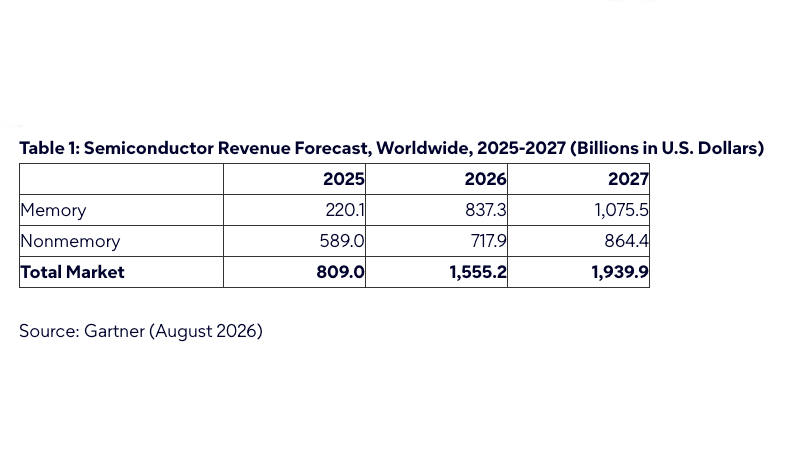
Gartner's latest forecast shows that "global semiconductor revenue is expected to reach US$1.555 trillion in 2026, up 92% from US$809 billion in 2025, and is projected to increase further to US$1.


