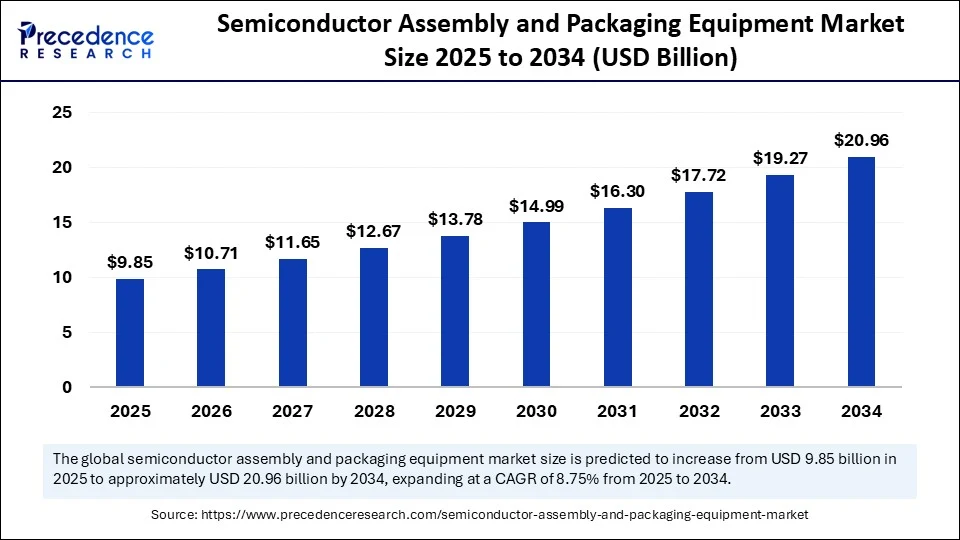
The global semiconductor assembly and packaging equipment market size accounted for USD 9.06 billion in 2024 and is predicted to increase from USD 9.85 billion in 2025 to approximately USD 20.96 billion by 2034, expanding at a CAGR of 8.75% from 2025 to 2034. The growth of the market is driven by the rising demand for smaller, faster, and more efficient electronic devices and advancements in packaging technologies.
Impact of AI on the Semiconductor Assembly and Packaging Equipment Market
Artificial intelligence (AI) is reshaping the semiconductor assembly and packaging landscape by enabling smarter, faster, and more precise assembly processes. AI-powered inspection systems are improving yield rates by detecting microscopic defects that human eyes or conventional tools might miss. Predictive maintenance driven by machine learning is reducing equipment downtime and enhancing production efficiency. Moreover, AI supports real-time data analytics for process optimization, enabling manufacturers to respond quickly to variations in materials or operating conditions, make informed decisions on the factory floor, and reduce reliance on manual interventions.
Asia Pacific Semiconductor Assembly and Packaging Equipment Market Size and Growth 2025 to 2034
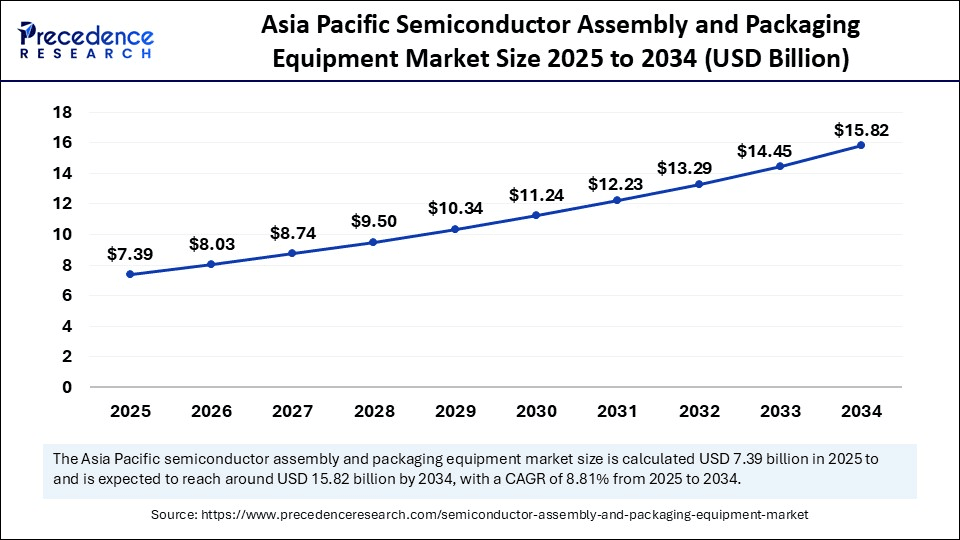
Asia Pacific semiconductor assembly and packaging equipment market size was exhibited at USD 6.80 billion in 2024 and is projected to be worth around USD 15.82 billion by 2034, growing at a CAGR of 8.81% from 2025 to 2034.


Stay up to date with the latest in industry offers by subscribing us. Our newsletter is your key to receiving expert tips.

As the memory chip shortage is expected to persist through 2027, independent smartphone and laptop manufacturers are being forced to redesign products, screen incoming chips for counterfeit or substan

Yageo posted year-over-year and month-over-month revenue growth in August, extending its streak of record monthly highs to a sixth straight month. The passive components maker said strong AI-related d
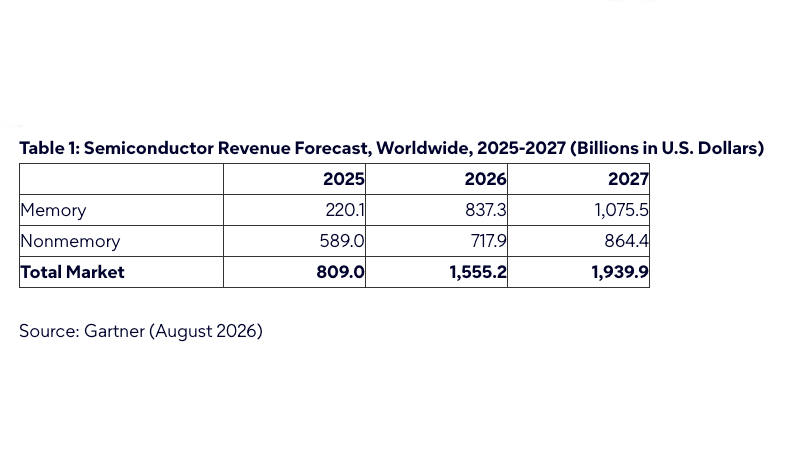
Gartner's latest forecast shows that "global semiconductor revenue is expected to reach US$1.555 trillion in 2026, up 92% from US$809 billion in 2025, and is projected to increase further to US$1.


